Delphine meets Eva and joins Waldvogel’s Meats
The Master Butchers Singing ClubDelphine’s first meeting with Eva Waldvogel turns an ordinary purchase at Waldvogel’s Meats into a new beginning. Arriving in the aftermath of the deaths in Roy Watzka’s cellar, Delphine is searching not only for food but, though she cannot know it yet, for the maternal recognition she has missed. Eva’s welcome into her kitchen offers immediate practical care; the work that follows gives Delphine a place in the Waldvogel household and a path toward becoming one of Argus’s most capable businesswomen.
An encounter shaped by grief
Delphine enters the shop with a wrapped purpose: she needs bacon to fry fish in the grease, and asks for a quarter pound. Eva asks what kind of fish, then gradually places the customer through the details of her father’s old icebox. When Delphine gives Roy Watzka’s name, Eva understands enough to invite her behind the counter. She offers to teach Delphine to make mincemeat pie, insisting that its quality depends on the suet. A transaction has become a welcome, and the older woman’s directness makes room for a relationship before either has named it.
The timing matters. Delphine has just come through a crisis at her father’s house and has been longing for a clear look at her dead mother’s face. That desire is attached to objects she has kept: photographs of her mother in a bureau drawer and a small white stone, wrapped in muslin and stored in a cigar box, that she once held in her mouth for comfort. At the shop, the yearning for a mother she barely knew meets Eva’s unforced attention. The encounter does not erase Delphine’s loss; it gives her a living person toward whom that need can turn.
Eva’s kitchen and Delphine’s disclosure
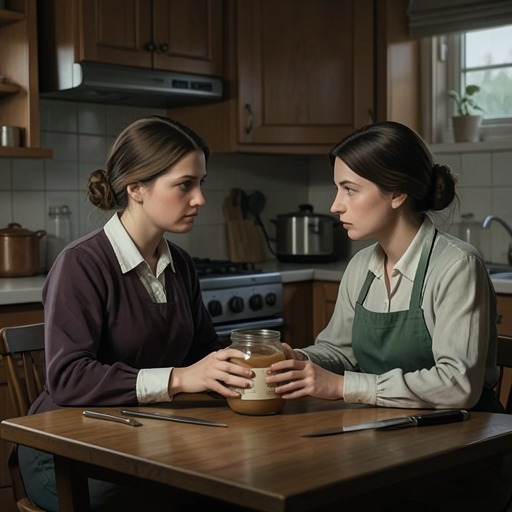
Eva leads Delphine through the shop and into a bright kitchen. The route passes an office crowded with papers and bills and a shelf of German porcelain figures; the kitchen itself is carefully equipped, with green-painted cupboards, a flour bin, a heavy meat grinder, and geraniums at the window. For Delphine, entering the room brings a sudden sense of quiet and expansion. As Eva grinds coffee by hand and begins preparing it, Delphine feels briefly settled, as if she has found a place where she can stop bracing herself.
Eva writes out a mincemeat recipe in ornate German handwriting, misspelling some English words. Delphine takes confidence from this small imperfection. She has regarded Eva as so assured—as a butcher’s wife and mother of four sturdy sons—that she might otherwise have seemed beyond reach. The recipe makes Eva more approachable, and Delphine decides to tell her what has happened at Roy’s house. She knows that the story will circulate as gossip, but chooses to give Eva the first account herself rather than let the town define it for her.
Eva listens without demanding a defense or offering a lecture. Instead, she gives Delphine fresh coffee and a cinnamon bun. When one of her young sons briefly enters the kitchen for a roll, the ordinary presence of a child sharpens Delphine’s awareness of the child who died in the cellar. She breaks down in tears. Eva tells her to quiet herself, puts a hand on her shoulder, and brings more coffee. Her reassurance that Delphine seldom weeps leaves Delphine feeling unexpectedly strong, not ashamed of having cried.
From welcome to work
Delphine leaves with groceries as well as the memory of Eva’s hospitality, and feels that she might be able to face Roy again. The pleasure of being noticed and invited into the kitchen is so new that she doubts it can last; she imagines it may have been a one-time kindness. Yet she leaves with a concrete hope: someday, she says aloud, she will have a kitchen like Eva’s. The sheriff’s car, an undertaker’s hearse, curious neighbors, and the exhausted Cyprian at Roy’s house bring her back to the immediate consequences of the cellar deaths, but the encounter has already given her a different future to picture.
When Delphine returns to the shop with Cyprian, she has walked roughly four miles rather than use gasoline. Eva again invites her to sit for coffee. Delphine needs help finding a way to remove the persistent odor in Roy’s house, and Eva proposes a sequence of cleaning measures, including vinegar and water and, if needed, stronger products. She also suggests filling in the cellar with wood ash and dirt. The advice is practical, but it carries the weight of Eva’s attention to the difficult conditions Delphine is trying to manage.
Fidelis Waldvogel appears, speaks with Eva, and leaves without asking to be introduced. Delphine is glad not to have to meet him yet: she wants to preserve her connection with Eva and is also interested in a job that Eva soon offers her, waiting trade. She is immediately pleased by the prospect of working in the shop and taking her breaks in Eva’s kitchen. Eva tells her to start the next morning at six; Delphine promises to be there when the doors open.
Learning the shop and building a place
From the next day, Delphine enters through the back of Waldvogel’s Meats, passes the furnace, washtubs, tools, and drying aprons, and takes Eva’s blue apron from its hook. The work brings her into the shop’s full routine: the cooler and deep freeze, the smoking room with hickory and apple wood, the processing room with its work surfaces and butcher blocks, and the daily cycle of collecting and washing stained aprons and rags. Eva lets her bring her own laundry, too. The smell associated with Roy’s house does not vanish at once, but gradually the smells of the meat shop replace it, and Delphine grows accustomed to them.
Her employment is more than a way to earn money or occupy herself. Eva has offered a form of maternal care that Delphine had rarely been able to request from anyone; the kitchen becomes the place where that care is made ordinary, through meals, coffee, advice, and the expectation that Delphine will return the next morning. At the same time, the shop gives her work whose routines and responsibilities she can learn. A first conversation over lard develops into a lasting association between belonging and competence.
Delphine’s role expands over time. She comes to take pleasure in selling the shop’s goods and adopts Eva’s conviction that Fidelis’s products are exceptionally good. She develops a practical sense for what customers will buy, when to reduce prices, and how to serve both better-off patrons and poorer neighbors. She introduces a weekly grocery drawing, makes careful arrangements with farms and a wholesaler, and adds goods ranging from beans and peas to soap, health remedies, oils, and fresh dairy products. During wartime shortages, she argues with suppliers over rationing, adjusts the shop’s offerings, and devises advertisements. The employee who first wanted to sit in Eva’s kitchen grows into a person who helps sustain the business and the town’s everyday exchange.
A lasting change in Delphine’s life
The meeting’s significance lies in the connection between private care and public work. Eva does not rescue Delphine from grief by making it disappear; she receives Delphine’s account, feeds her, and offers a place at the counter. Delphine, in turn, makes that welcome durable through daily labor, business judgment, and attachment to the household. Over the years she becomes one of Argus’s respected and stable women, known for her advice, thrift, and ability to manage the shop. What begins as a solitary customer’s approach to a butcher’s counter becomes a chosen family bond and the foundation of Delphine’s life in the Waldvogel household.